
Some projects come and go. London Pavement Geology has been part of life at Livetech for more than a decade, and this autumn it has had its biggest upgrade yet. It feels like a good moment to look back at how it started, how far it has come, and what has just changed.
Where it started
The idea belongs to Dave Wallis, a geologist with 45 years in the oil and gas industry behind him, who had wanted to build a guide to the rocks in London’s streets since he was a student in the 1960s. The expertise behind every entry comes from Dr Ruth Siddall, a geologist and writer, then at University College London and now a research fellow at Trinity College Dublin, who has spent years recording and identifying building stone in cities across Britain. Between them they set out to answer a simple question: what is that wall, column or doorstep actually made of, and where did it come from?
London Pavement Geology went online in late 2014, mapping locations in central London, each with its stone, its age, where it was quarried and a photograph. In early 2015 Ruth offered around 700 of her own recorded London sites, and the map grew quickly from there: past 800 locations by July 2015, more than 1,500 by July 2017, and in January 2018 the site opened up to submissions from anywhere in the UK. We built the free Android and iPhone apps that followed, with version 1.0 arriving in August 2016, and the project was supported by awards from organisations including the PESGB, the Geologists’ Association and Geoscience Wales.
A bit of press
The project caught people’s imagination early. Popular Science spotted it in July 2015, and in January 2016 the Guardian suggested readers beat the post-Christmas blues by going rock spotting, pointing them to Ruth’s London guides, the same work that forms the basis of the database. That summer CityLab, Hyperallergic and Londonist all covered the map, GEO ExPro wrote it up that December, and the Geological Society’s Geoscientist magazine reviewed the app. Not bad for a database of paving slabs and shopfronts. The interest has not gone away either. Stone-Ideas featured the project in 2024, and in October 2025 BBC Future joined Ruth fossil hunting in the City of London for a feature on urban geology that featured London Pavement Geology.
As featured in








Where it is now
The collection has grown far beyond central London. It now holds more than 4,300 stone records at around 2,800 buildings and places across England, Scotland and Wales, from St Paul’s Cathedral to Marischal College in Aberdeen, covering 163 different types of stone. Many of them came from members of the public, and every submission is checked by Ruth before it goes live. That review process is what makes the data trustworthy, and it is why the site asks people to submit a location rather than simply add one.
The 2026 upgrade
This year we rebuilt the site from the inside out, keeping all of Dave and Ruth’s content and making it far easier to explore, find and trust. It starts with a new identity: the road receding into the distance is still there, but now it runs towards a London skyline, with St Paul’s on the horizon, because most of the stone in the collection is in buildings rather than underfoot.

The highlights:
- A new look. The new logo, a cleaner design throughout, and a home page slider of famous buildings with a close-up of their stone.
- Easier to explore. A simpler menu, a new Browse section that lets you work through every location by name, stone type, geological age, architect or nearest station, and a “what is near me” button that finds the closest records to where you are standing.
- Better record pages. Every location now has a proper heading, its key facts at a glance, described photographs, nearby buildings to visit next and a simple way to share a find with friends.
- Found by search engines. All 4,360 records are now in the site’s sitemap and linked from the browse pages, so Google can actually find them. Before the upgrade, almost nothing on the site linked to them at all.
- Faster and more secure. Outdated code libraries replaced with current, supported versions, over a megabyte of wasted downloads removed from every record page, and accessibility improvements throughout.
- Privacy taken seriously. Google Analytics now only runs once a visitor has agreed to it, a cookie banner with a genuine reject button, and rewritten privacy, cookie and terms pages.
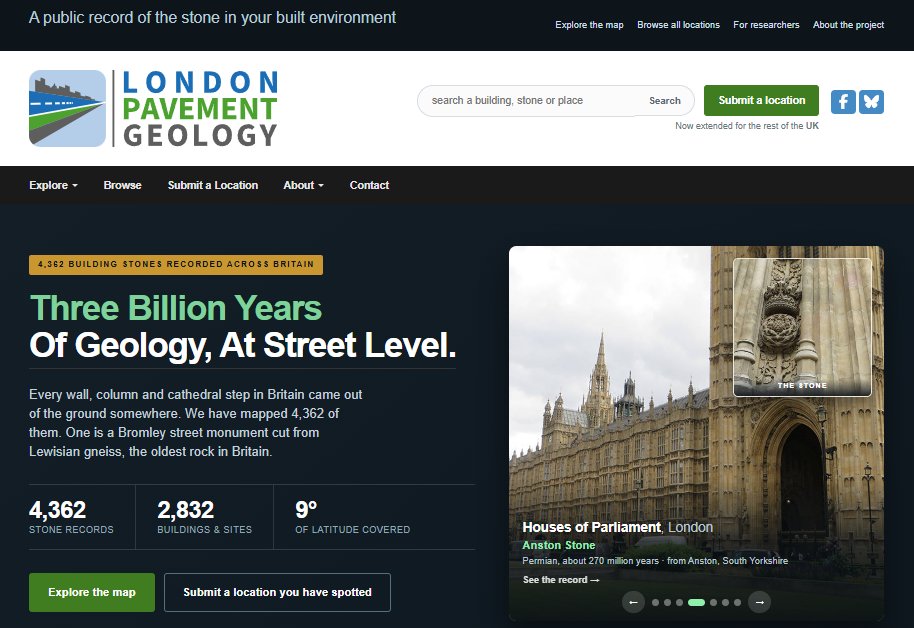
There are a few lighter touches too, including a 404 page that admits the page you wanted “has crumbled”, and a page introducing Ruth’s own series of more than 50 urban geology walking guides.
What we have learned
We have loved every minute of working on this project. Working with Dave and Ruth has been a reminder that the best websites are built around real expertise and a clear purpose. Our job has never been to change what the project is, only to help more people discover it and enjoy it. More than a decade in, the stone has not moved, but the way people find it has changed completely, and the site now reflects that.
Next time you are waiting for a bus, take a closer look at the building beside you. It might be 150 million years old. You can find out at londonpavementgeology.co.uk.
If you have a specialist project, a society or a database that deserves a wider audience, we would love to hear about it. Have a look at our web design work or give us a call.